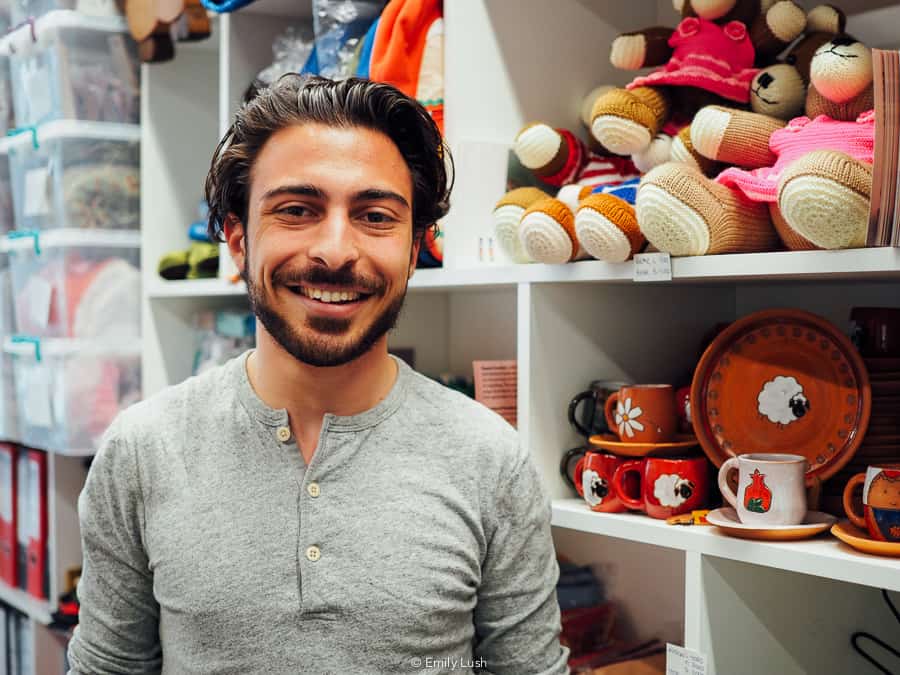
A WFTO Asia Provisional Member since 2015, Homeland Development Initiative Foundation (HDIF) stands out for many reasons. Based in Armenia at the crossroads of Asia and Europe, HDIF is not only one of the country’s original Fair Trade social enterprises, it’s also the first WFTO Member organisation in a post-Soviet country. HDIF was created in 2013 with the goal of supporting artisans in disadvantaged communities. Founder Timothy Straight, who gained experience in Fair Trade working as a designer for Selyn in Sri Lanka, saw Fair Trade as an opportunity for Armenia to leverage its rich heritage of arts and crafts to create sustainable jobs. HDIF now supports an extensive network of artisan partners who make toys, homewares, textiles and other products that showcase Armenian craftsmanship and materials. WFTO Asia contributor Emily Lush recently caught up with Shaunt Tchakmak, Marketing Manager at HDIF, in Yerevan to find out more about the organisation’s pioneering work in Fair Trade in the Caucasus region. Who does HDIF work with, and what are some of the challenges they face? HDIF works with 16 producer groups all over Armenia. In total, we represent approximately 200 artisans – 90% of whom are women – and most of whom live in villages near Armenia’s borders. One of the goals of our organisation is to focus on Armenia’s most vulnerable regions, and those are usually the areas furthest away from the capital, Yerevan. The poverty rate in Armenia is over 40%. Almost everyone outside of Yerevan lives in pretty harsh conditions, and most of our artisans are local women who have been in the village their entire life. We also work with Syrian-Armenian refugees in Yerevan. What role do handicrafts play in Armenia’s socio-economic development? The handicraft industry is something HDIF has identified as a tool to meet our goal of job creation. A lot of Armenians are constantly trying to find a way to leave this country, and having a source of income is something that will allow them to stay. From ceramics to crochet to felting to knit-work, it’s all here in Armenia. HDIF has never had to engage in any sort of skills training because we’ve never walked into a village and found there’s no skills we can work with. Even when the same skills are practiced in different parts of the country, the final product will often be completely different. For a lot of women, handicraft work has always been a hobby. They have never viewed their skills as something that could be a job or a source of income. These artisans are mostly just lacking designs and access to the market, and that’s where HDIF steps in. What does HDIF do to assist artisans? When we decide to work in a specific village, we must first ensure that artisans there can work together in an organised group in order to meet large orders. Groups need to be registered as their own legal entities, which all our partners now are. HDIF’s partners are absolutely free in terms of developing products and marketing them on their own. The only time they are limited is if they’re producing a product that we design. We’re at a stage now where we have a good number of producer groups, so our focus is on building them up areas like quality control, production capacity and marketing. We create a logo for each and every one of them. We assist with product design, and we help artisans scale-up their work and find new export channels. Ingraining business skills and values is something we’re trying to push among our partners now. This tends to happen organically. For example, groups need to invoice us for products. If products are sent to HDIF without an invoice, we won’t put them on the shelf. If a product shows up in our office and the quality is not there, we make a point of sending it back. This might happen once or twice, but after that, it won’t happen again. Through HDIF working in this specific way and setting this example, our partners need to learn those skills. We help to guide them through these processes. Who buys HDIF products? HDIF has distributors and clients all over the world – in Canada, Norway, Germany, Sweden, Russia, France. Our main market is split in two. We have the Armenian diaspora, which has always been very supportive. These people are very active in their community back home and place a lot of importance on whether or not a product is made in Armenia. Secondly, being a Member of WFTO Asia is giving us access to the broader Fair Trade market through international events such as Ambiente. What sort of benefits do you see for the artisans you work with? When I started at HDIF as a volunteer, the first thing I did was interview a lot of our producers to understand what it is they gain from working with us. For them, it’s really a huge source of encouragement to know there’s somebody out there looking to help them and to provide them with an opportunity. To experience an environment where they can see their products being marketed to other Armenians and being sold – being taken to a fair in Germany and displayed there, to have a US distributor selling their work abroad – this is all very encouraging for them. We don’t see they money our partners earn as their main source of income; but it definitely does help to make their lives more comfortable. Many of our partners put the money they earn aside for their children’s education. Other artisans derive different benefits. For example, we work with a disabled woman in the north of the country who went from being a liability for her family to a source of income today. Domestic violence is a huge issue in Armenia, and a lot of women who find themselves in that situation are stuck because of economic dependency. Having another source of income could potentially...

0Pas de commentaire
Please type the two words below