Basket
Clean basketTotal:
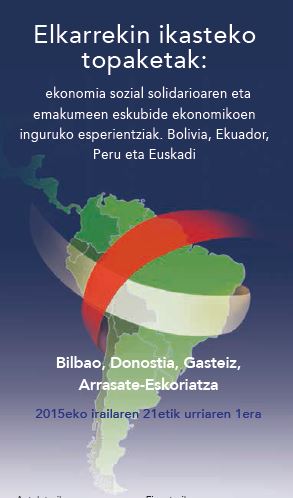
Poz handiz gonbidatzen zaituztegu “ELKARREKIN IKASTEKO TOPAKETAK: EKONOMIA SOZIAL SOLIDARIOAREN ETA EMAKUMEEN ESKUBIDE EKONOMIKOEN INGURUKO ESPERIENTZIAK. BOLIVIA, EKUADOR, PERU ETA EUSKADI”, izenburua duen mintegian parte hartzera. Mintegia Zubiria Etxeko Graduen Aretoan (Sarrikoko Ekonomia Zientzien Fakultateko Campusean, Bilbon) izango da Irailaren 25ean Peruko Ela Pérez, Ecuadoreko Jhonny Jiménez eta Boliviako Darío Alanocaren presentziarekin.
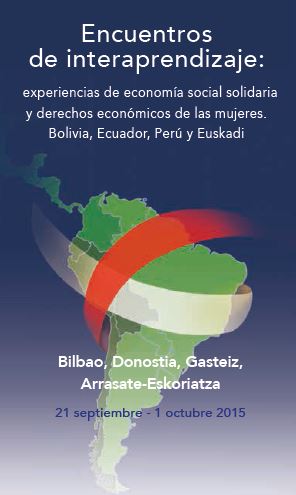
Hegoa organiza el seminario ENCUENTROS DE INTERAPRENDIZAJE: EXPERIENCIAS DE ECONOMÍA SOCIAL SOLIDARIA Y DERECHOS ECONÓMICOS DE LAS MUJERES. BOLIVIA, ECUADOR, PERÚ Y EUSKADI, con Ela Pérez (Perú), Jhonny Jiménez (Ecuador) y Darío Alanoca (Bolivia), que se celebrará en el Salón de Grados de Zubiria Etxea, en el Campus de la Facultad de Ciencias Económicas y Empresariales de Sarriko (Bilbao), el viernes 25 de septiembre de 2015.
17 tonnes de nourriture en 3 mois, juste en ramassant le surplus des producteurs! L’association Re-bon n’a presque eu qu’à se baisser pour se servir…
We are pleased to announce the publication of a new book by former UNRISD Research Coordinator, Yusuf Bangura, Development, Democracy and Cohesion. The book—part of a series called Critical Essays with Insights on Sierra Leone and Wider African Contexts and published by Sierra Leonean Writers Series—is a collection of 43 essays, written while he was at UNRISD. Yusuf Bangura uses his insights into Sierra Leone and Africa in general to shed light on the challenges of building developmental, democratic and cohesive states and societies.
The global development financing framework has shifted in emphasis since the 2002 Monterrey Consensus in three ways. First, the Addis Ababa Action Agenda (AAAA) of the Third Conference on Financing for Development moves away from a more balanced sharing of responsibilities between developed and developing countries in the international financial architecture. Second, the document reflects a clear endorsement of the private sector as a privileged development actor. Third, the AAAA takes an instrumentalist view of women’s human rights. As a result, the Conference failed to remove global obstacles to development and to provide the structural conditions and means to move toward sustainable and equitable development patterns and the full realization of human rights, particularly women’s rights. However, the AAAA offers possibilities for continued engagement through the establishment of an FfD follow-up mechanism as a space to redefine the balance of power and negotiate proposals to overcome the regressive trends and reshape the agenda.

daniel