Cesto
Limpar cestoTotal:
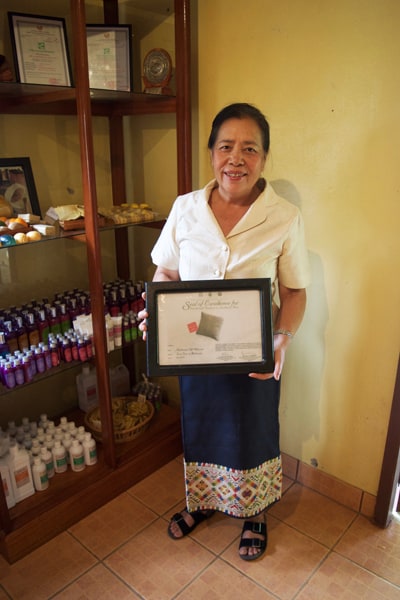
In 2005, an international group of women activists submitted the names of 1,000 women as a collective nomination for the Nobel Peace Prize. Although they did not win, PeaceWomen Across the Globe is still active, after producing a book, a film and an exhibition about the women they chose. One of those women was Kommaly Chanthavong, Director of Phontong-Camacrafts Handicrafts Cooperative and Mulberries. She is recognized for her contributions to social and economic development in Laos. Kommaly was only 11 years old when her village was destroyed by U.S. bombers. She walked for a month to reach the capital, Vientiane. There, she met many other displaced and desperately poor families, most of them without any marketable skills. In 1976, she formed a cooperative with 10 members to share the silk-weaving skills her family had practised for generations. In 1990, they included Hmong and Lao village women, and in 1993, they established an organic silk farm. Today, the cooperative consists of 3,000 farmers, weavers and artisans from over 200 village families. Mulberries is their model farm and their Fair Trade logo. What makes Laos silk special? Laos’s silk production is traditionally natural and has not been changed or modernized. The breed of caterpillar we use hasn’t been changed. It’s been passed down from generation to generation without mixing with any other breed. In addition, because of the climate, the texture of Laos silk is different to other silks. It’s more like cotton or linen, which gives a specific quality to our work. The traditional patterns have also been passed down to us through the generations. The patterns may be adapted as they are passed on, but we still have the original designs as well. It’s like treasure being passed from hand to hand, down the generations. The patterns we use are not copied from anyone or anywhere else — they’re unique to this area. When children are learning how to weave, their parents teach them the different meanings of patterns. Girls start weaving between the ages of 14-16, around the time they start to have boyfriends. Perhaps their boyfriends will work outside or leave the village to study, so the girls weave them a gift to take. The message in it can have a pattern of the stars, which is a message to the boy that says, “If you miss me, look at the stars and think of me”, when they are apart. What drives you; what motivates your work? As a young girl, I wasn’t allowed to go to school, but I would sit outside the classroom and listen in on the classes. Educational opportunity in the north is very limited for women. We are expected to help with housework and be good at weaving – the future husband’s family judges the suitability of a girl by the strength of her silk skills: from the rearing of the mulberry tree to silk worms, to spinning and weaving. Also, I experienced war when I was young. We experienced a lot of war — the war of independence from France and then the Vietnam War. When we had to go the caves for safety, we would take our weaving materials and silk worms with us. Such is the love and connection we have to our worms and our work. I came back to this area to see how my family was doing, but I also wanted to preserve our culture, our traditions and the land. Our workers get money to send their children to school. We also encourage mothers to pass on their skills to their children, in order to preserve them. We welcome anyone who wants to come here to learn these skills. For us, a priority is that the women make clothes for their own use, not just for selling — so they don’t have to go to the market and they are not making pieces that they themselves cannot wear. If they make more then we buy from them, there is still a market for them. How does your Fair Trade and Organic model shape your work? We plan our work around the land and the farmers’ harvest. The silk workers don’t plan around us – we accommodate their needs. We were always organic, but we didn’t set out to be Fair Trade. Once we learnt the meaning of it, however, we realized we already met the criteria. Our work supported the poor villagers. Producing goods organically means the workers, consumers and environment are all safe. Women in rural areas don’t have the money to buy chemicals and we don’t want a dependency on them, so we teach them how organic can work. Where do you find happiness? My dream was for my children to study overseas, find very good jobs and work in a high-rise building. When this actually happened, I saw that in reality, my children were always chasing time, running to work, rushing for deadlines. That’s not happiness, so I try to bring my children back to live with nature and to help continue this work. That’s my happiness. Think less about money and materials, live a more sustainable way and love and be happy with what you have. If you have something small or large share it with others. (image credit: Mia Hardrill) About Author: Mia Hadrill is an advocate for Fair Trade and sustainability; she previously held a position at WFTO-Asia as Communications Manager. Prior to this, Mia worked directly with the CEO heading PR at People Tree, sustainable and Fair Trade fashion. Mia’s a CIPR Accredited Practitioner in Public Relations (PR), experienced in communications and advocacy for social businesses. Mia has also worked in advocacy for The Leprosy Mission, where she became a published author of an educational children’s book on leprosy. Mia’s experience extends to positions as a sustainable travel researcher and as PA to the Chair of the United Nations Association – Edinburgh.
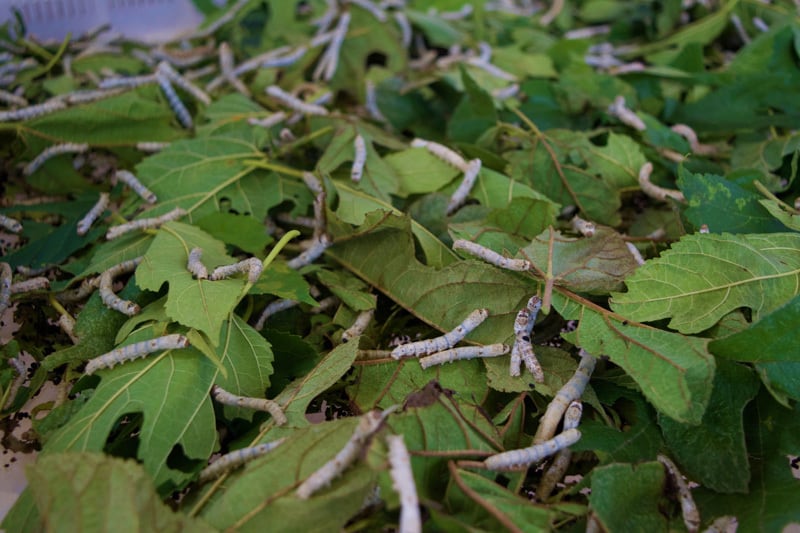
Located just outside Phonsavan, Mulberries Organic Silk Farm is a 45-hectare model farm dedicated to the revival and survival of all aspects of traditional Lao silk production. Mulberries’ mission is to “create income-generating opportunities for Lao people in a socially and environmentally responsible manner.” They provide rural villagers with training and support in silkworm rearing and in the traditional art and craft practices of weaving. An inordinate amount of work goes into producing a shimmering Lao silk garment, and the journey is as magical as the finished product. To follow this journey and get up close and personal with wiggly worms in the process, WFTO-Asia visited Mulberries’ founder Kommaly Chanthavong, and her daughter, Boby Vosinthavong, for a guided tour. It starts with leaves – luscious, green mulberry leaves. These are the main food for the silk worms. “This year has been very dry, so we’ve had to prune our trees very short, normally it’s to shoulder length,” explains Boby. The leaves are harvested and distributed to the villages that Mulberries work with, so the cooperative workers can fatten up the silk worms. The worms fatten up in purpose-built “nursing homes”. Mulberries build a worm house in each village, providing the materials free of charge. Inside, the worms munch and sleep. In one nursery, there can be up to 22,000 worms. They are treated to the best organic leaves, a cool breeze if they are too hot, and warm fires if it gets cold. Once they have had their fill, the worms are moved into a specially designed rotating frame to create the silk cocoon. The cocoons create the silk thread. One cocoon can produce about 150 to 300 metres of silk. This raw silk thread has three layers: outer, middle, and inner, with the inner layer providing the best quality. When the cocoons are ready, they are boiled and threaded using either a traditional or semi-automated model. The silk is then died using natural dyes. The whole site is blooming with different plants and flowers that are used to create an amazing array of natural colours, like indigo. Mulberries boasts an ability to create up to 100 different colours! The waste of making the dyes goes into composting. All the by-products of raising the silk worms and “harvesting” the silk thread are made into tea or skin care products, or composted. “It was always my vision,” explains Kommaly, “that the whole process from farm to finish would be organic, would be in relationship with the land and what we produce.” After the dyed silk is dried, the weavers take it to their wooden looms and create intricate patterns rich with meaning. In the North of Laos, the Naga, a water dragon famous in Laotian folklore, is visible in many designs. Kommaly shows us a scarf and explains that “the pattern shows a love story between an elephant and a Naga. It’s a cross love, like a foreigner marrying a Laotian – their love story.” Love seems to be a theme at Mulberries. Kommaly is still passionately involved in her work. When WFTO-Asia asked her what her secret is, she said: “My passion comes from love and the way that I was raised. I grew up in a community where we all supported one another. There was no market, so we had to be self-sufficient, and we helped, cared, provided for and sustained one another. I wanted my business to be one where people were not just thinking of material things and destroying the environment. I wanted my workers to be able to work with love, to share and care for one another as a community. Love is the most important thing.” (image credit: Mia Hadrill) About Author: Mia Hadrill is an advocate for Fair Trade and sustainability; she previously held a position at WFTO-Asia as Communications Manager. Prior to this, Mia worked directly with the CEO heading PR at People Tree, sustainable and Fair Trade fashion. Mia’s a CIPR Accredited Practitioner in Public Relations (PR), experienced in communications and advocacy for social businesses. Mia has also worked in advocacy for The Leprosy Mission, where she became a published author of an educational children’s book on leprosy. Mia’s experience extends to positions as a sustainable travel researcher and as PA to the Chair of the United Nations Association – Edinburgh.

The Small Industries Development Bank of India (SIDBI) has tracked the same path as the Government of India (GOI) in encouraging start-ups in the micro, small and medium enterprise (MSME) space, ranging from agriculture to social sectors. The GOI’s “Start-up India” initiative is aimed at fostering entrepreneurship and promoting innovation by creating an eco-system that […]
The post SIDBI catalyzes MSME start-ups in India appeared first on ADFIAP.

Unfortunately, whenever civil society and government strike discussions on human rights a certain unease sets in. The mood quickly dampens. On one hand, government mounts a defensive posture and on the other, civil society embarks on an offensiv...
Se ha celebrado en Manchester la primera reunión del proyecto europeo ‘Saving Jobs!’, cuyo objetivo es ampliar las posibilidades de la transferencia de empresas a los trabajadores, preferentemente en forma cooperativa.
Según se explica desde COCETA, durante el proyecto, que durará hasta 2017, la idea es transferir el conocimiento que se tiene en España hacia los socios europeos -Reino Unido, Polonia y Dinamarca-, así como a autoridades locales en Europa, a través de la Red Europea de Municipios por la Economía Social (REVES, por sus siglas en inglés), con menos experiencia en estos temas.
España tiene una larga trayectoria en la transferencia de empresas a sus empleados. Desde la década de los 80, las empresas españolas han estado transfiriendo empresas a sus trabajadores, ya sea por crisis y quiebras como por jubilación de sus dueños.
El encuentro de Manchester fue el punto de partida para preparar el grupo de herramientas, talleres, seminarios y actividades ofrecidas por los expertos de las organizaciones miembro de COCETA, coordinadora del proyecto, hacia los socios y los grupos de interés.
Por parte de España participan las comunidades autónomas que más han trabajado en el ámbito de la transferencia de empresas: la Unión de Cooperativas de Trabajo Asociado de la Región de Murcia (UCOMUR), la Asociación Navarra de Empresas Laborales (ANEL), la Federació Valenciana de Cooperatives de Treball Associat (FEVECTA), la Federació de Cooperatives de Treball Associat de Catalunya (FCTC) y la Federación Andaluza de Empresas Cooperativas de Trabajo Asociado (FAECTA).
Participantes del Reino Unido, Dinamarca y Polonia
En la reunión de Manchester, delegados de las organizaciones europeas participantes -Co-operatives UK; Kooperationen, de Dinamarca; y NAUWC, de Polonia- explicaron sus contextos locales a la hora de transferir empresas a sus empleados.
En países como Polonia la sola palabra “cooperativa” está relacionada con una historia comunista, plagada de corrupción y burocracia. Tampoco son conocidos los beneficios de las cooperativas de trabajo en países como Reino Unido o Dinamarca, aunque sí tienen en estos países una fuerte cultura de trabajo colectivo.
REVES, la organización europea de economía social participante, que tiene sede en Bruselas, llevará a cabo un análisis profundo sobre las diferentes situaciones. Otras reuniones, talleres y seminarios tendrán lugar durante el año de trabajo en cada uno de los países miembro; y los representantes de cada una de las organizaciones visitarán ejemplos de empresas reconvertidas en España. Al final de las actividades habrá un seminario y acto de clausura, que tendrá lugar en Bruselas.
Los beneficios de las cooperativas de trabajo
Las cooperativas de trabajo asociado son un modelo que ayuda a mejorar la vida de las personas y sus comunidades. Están basadas en valores cooperativos como la democracia, la solidaridad y la responsabilidad. En contraste con las empresas tradicionales, los trabajadores de las cooperativas participan en sus beneficios, en las decisiones de la empresa y en la organización, a través de prácticas democráticas. Los trabajadores tienen la mayoría de los votos en las asambleas.
El modelo ha probado ser una herramienta efectiva para crear y mantener empleo sostenible, de calidad; generando riqueza y mejorando la vida de trabajadores y de la comunidad donde están insertas.
Ha demostrado también ser eficaz para posibilitar el mantenimiento de empresas en situación de crisis o por ausencia de sucesión tras el fallecimiento de su dueño.

daniel